
Technical product management has become a discipline of systems thinking, not just feature delivery. The modern end‑to‑end product lifecycle PMs must operate includes: discovery → launch → growth → sunsetting. Customer expectations shift quickly, software architecture choices affect business models, and artificial intelligence has impacted both what products can do and how teams build them. The strongest product managers connect these realities to strategy, discovery, delivery, measurement, commercialization, and risk management. That connection is what separates a roadmap owner from a product leader.
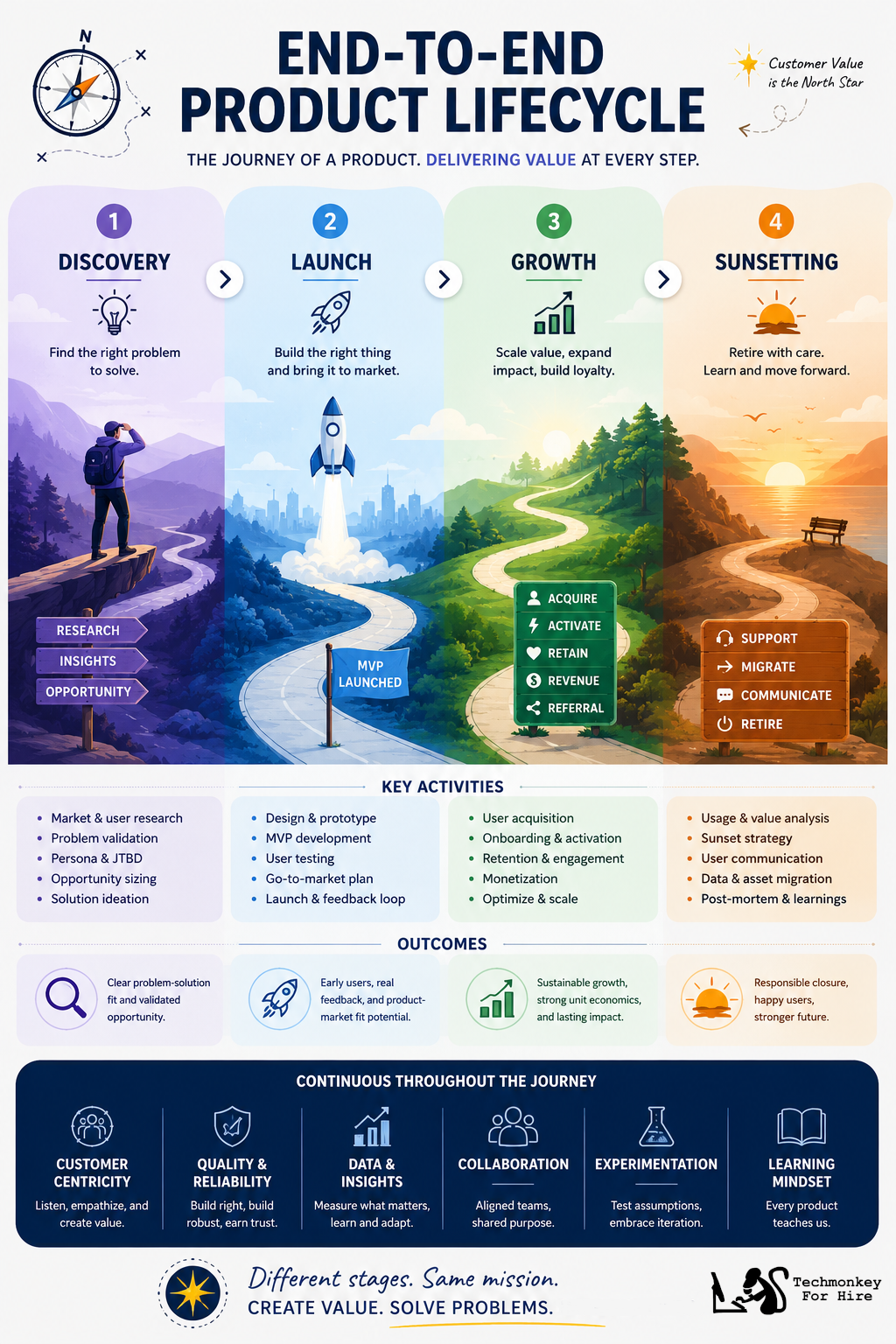
The practical starting point for modern end‑to‑end product lifecycle (discovery → launch → growth → sunsetting) is disciplined curiosity. Product teams often say they are customer-centric, but many still rely on stakeholder requests, sales anecdotes, or a few loud customers. A more mature approach builds a repeatable learning system. That system combines qualitative discovery, behavioral data, usability evidence, and commercial context. The goal is not to collect endless feedback. The goal is to reduce uncertainty before the team commits expensive engineering capacity. This goal state is clearly easier said than done, as all our collective experiences feel the gravity of customer “bugs and issues” pulling our feature-building capacity back toward reactive effort rather than proactive effort.
Teresa Torres[2] proposes continuous discovery habits to reframe discovery as a weekly operating rhythm rather than a phase that happens before delivery. SVPG[1] has similarly emphasized that discovery and delivery are both essential responsibilities of empowered product teams. In technical environments, this matters because every product decision carries hidden implementation, data, security, integration, and operational consequences. The earlier those constraints surface, the less likely the team is to ship something that looks good in a deck but fails in production. The keyword here is “empowered.” In real-world implementations of a product organization, the definition of “empowered” varies widely.
A best-practice approach begins by clarifying the customer’s problem in language customers would recognize. The Jobs-to-Be-Done method is useful in these cases because it pushes the team to focus on the progress customers are trying to make, rather than solving for a “market segment.” For example, an analytics dashboard is not simply serving managers. It may be helping a revenue leader detect pipeline risk before the quarter closes, or helping a support leader identify product defects before churn rises. Those are different jobs, and each job implies different workflows, success metrics, and willingness to pay.
Strong PMs listen for repeated patterns, inspect behavior, observe workflow friction, and test whether proposed solutions change real choices. This is especially important in B2B products, where the buyer, administrator, daily user, compliance reviewer, and economic sponsor may each have a different definition of value. This method, while a bit difficult to realize in real-world workflows, is more effective than customer interviews and surveys.
In practice, a modern end‑to‑end product lifecycle should lead to sharper decisions about what not to build. Product teams create leverage when discovery identifies the few constraints that matter most: the painful workflow step, the missing integration, the trust barrier, the adoption trigger, or the economic event that makes the problem urgent. The output should not be a thick AI-generated research report that no one reads. It should be a clear opportunity narrative, evidence-backed assumptions, and a set of experiments that can be run before the roadmap hardens.
The best teams make discovery visible. They maintain opportunity maps, assumption logs, research repositories, and decision records that help engineering, design, sales, support, and executives see why the team is making tradeoffs. This level of visibility is difficult to achieve due to the cross-functional alignments required. That said, the new era of AI agents that integrate tools, mine internal documents, meeting transcripts, and even CRM databases should be less of a barrier. Product orgs with this level of preparation would prevent the organization from having to review every decision from the beginning and repeat discovery when a new stakeholder appears. It also helps teams preserve context when priorities change. This is so common it is nearly cliché. Yearly planned roadmaps are often derailed by mid-year, depending on the company’s size and which customer is loudest.
Ultimately, modern end‑to‑end product lifecycle is about building judgment. Product managers earn their place when they can say with certainty what is known, what is unknown, which risk is most expensive, and what evidence would change the decision. With the push toward AI-assisted research and automated synthesis, human judgment becomes even more important. AI can summarize interviews and feedback, but it cannot own the product call. The PM still has to understand incentives, interpret ambiguity, and decide when evidence is strong enough to act.
A practical operating model for modern end‑to‑end product lifecycle starts with ownership. In many organizations, product problems slow down because no one has clarified who decides, what information is required to make a decision, and how cross-functional misalignments are resolved. A concise decision SOP, regularly reviewed with retrospectives, is ideal because it makes assumptions visible, records tradeoffs, and gives cross-functional partners a shared object to critique.
Sequencing is the next part of the operating model because technical product work fails when teams try to answer every question at once. A better approach is to identify the assumption with the most risk and design the best mitigation around it. For example, if feasibility is uncertain, prototype the hard technical path before polishing the interface. If demand is uncertain, test the demand hypothesis through sales and account team meetings. Sequencing is about allocating scarce engineering, design, and leadership attention in the order that reduces uncertainty the most.
The third part of the operating model is explicit communication. Product teams should explain why the recommended path is better than plausible alternatives. This is especially important when stakeholders are close to revenue pressure, operational pain, or executive commitments. A PM who can compare options clearly earns more trust than a PM who simply defends a preferred answer. Good communication includes the customer problem, the evidence, the expected impact, the constraints, the risks, and the decision deadline. When those elements and data are clear, the discussion becomes more productive.
Post-decision learning is the last part of the operating model. Once a team chooses a path, it should define when the decision will be revisited and what evidence would trigger a change. This prevents product work from becoming rigid or chaotic. Teams can commit strongly while still learning honestly. This balance is essential in technical product management because new information often appears after implementation begins: integration complexity, model behavior, security constraints, sales objections, support burden, or unexpected user workflows. A mature operating model and an empowered PM org do not hide these discoveries. They turn them into better sequencing, clearer tradeoffs, and faster organizational learning.
A common failure mode in modern end‑to‑end product lifecycle (discovery → launch → growth → sunsetting) is treating discovery as validation. This happens when teams decide what they want to build, then search for confirming quotes, which is confirmation bias. Real discovery should be more uncomfortable by allowing the question to change the question, narrow the segment, expose weak assumptions, and sometimes kill beloved ideas. That discomfort is useful and protects the organization from spending months developing a solution to a problem or need that was not valuable enough.
The practical takeaway is to operationalize a modern end‑to‑end product lifecycle by first defining the decision the model should improve, the evidence the decision requires, the stakeholders the decision affects, and the metrics that will show whether the decision is working. The modern PM should not be rewarded for activity. The modern PM should be rewarded for judgment, alignment, and measurable outcomes. When this topic is treated as part of an integrated product operating system, it becomes a source of strategic leverage rather than another process artifact.
REFERENCES
[1] Silicon Valley Product Group, Continuous Discovery: https://www.svpg.com/continuous-discovery
[2] Product Talk by Teresa Torres: https://www.producttalk.org
[3] Harvard Business School Online, Jobs to Be Done: https://online.hbs.edu/blog/post/jobs-to-be-done-examples