
The product discovery techniques that make you successful in B2C can make you surprisingly ineffective in B2B. The problem is that the uncertainty you’re trying to reduce is fundamentally different. In B2C, you can often learn by observing individual behavior at scale: what people do, where they struggle, what they choose, and what makes them come back. In B2B, the person using the product may not be the person buying it, approving it, administering it, or benefiting financially from it. The workflow matters. The organization matters. The incentives matter. The technology and procurement constraints matter. When a product manager carries a B2C discovery playbook into B2B unchanged, they can become very good at answering the wrong questions. Great discovery starts with understanding what kind of uncertainty you’re facing, then finding the people, evidence, and experiments that can reduce it.
If Product Discovery Is About Reducing Uncertainty, What Changes Between B2C and B2B?
Consider two purchases. A person buying a movie ticket wants to see the movie, chooses which movie to see, pays for the ticket, and watches it, all in one continuous act carried out by one person. A company buying enterprise software rarely works that way. The person who experiences the problem, the person who uses the resulting solution, the person who decides which vendor to select, the person who pays, and the person who can quietly block adoption can be four or five different people, each with a different stake in the outcome. A discovery process built to understand the movie ticket buyer will not surface what any of those other roles need. The better question in a B2B context, however, is not who is the customer; it is who experiences the problem, who uses the solution, who decides, who pays, who can block adoption, and where the value is actually created.
Marketing and sales literature has a name for this cast of characters: the decision-making unit, or buying center. Frederick Webster and Yoram Wind formalized the concept in their 1972 paper on organizational buying behavior, arguing that a company’s purchase decision emerges from a group of people occupying distinct roles rather than from a single rational buyer (Webster and Wind, “A General Model for Understanding Organizational Buying Behavior,” Journal of Marketing). Later writers on the buying center distilled those roles into a practical set: the end user who lives with the outcome, the influencer who shapes opinion without controlling budget, the initiator who first feels the pain and pushes the organization to act, the economic buyer who controls the money, the decision maker who has final authority, and the gatekeeper who can slow or block the process entirely (Gust de Backer, “Decision Making Unit: B2B and B2C Buying Center”). In most consumer purchases, these six roles collapse into one person, or at most a small household unit of colleagues, friends, and family. In B2B, they routinely span five different departments, which is why a feature that delights the end user can still lose the deal if the economic buyer never sees a return on investment.
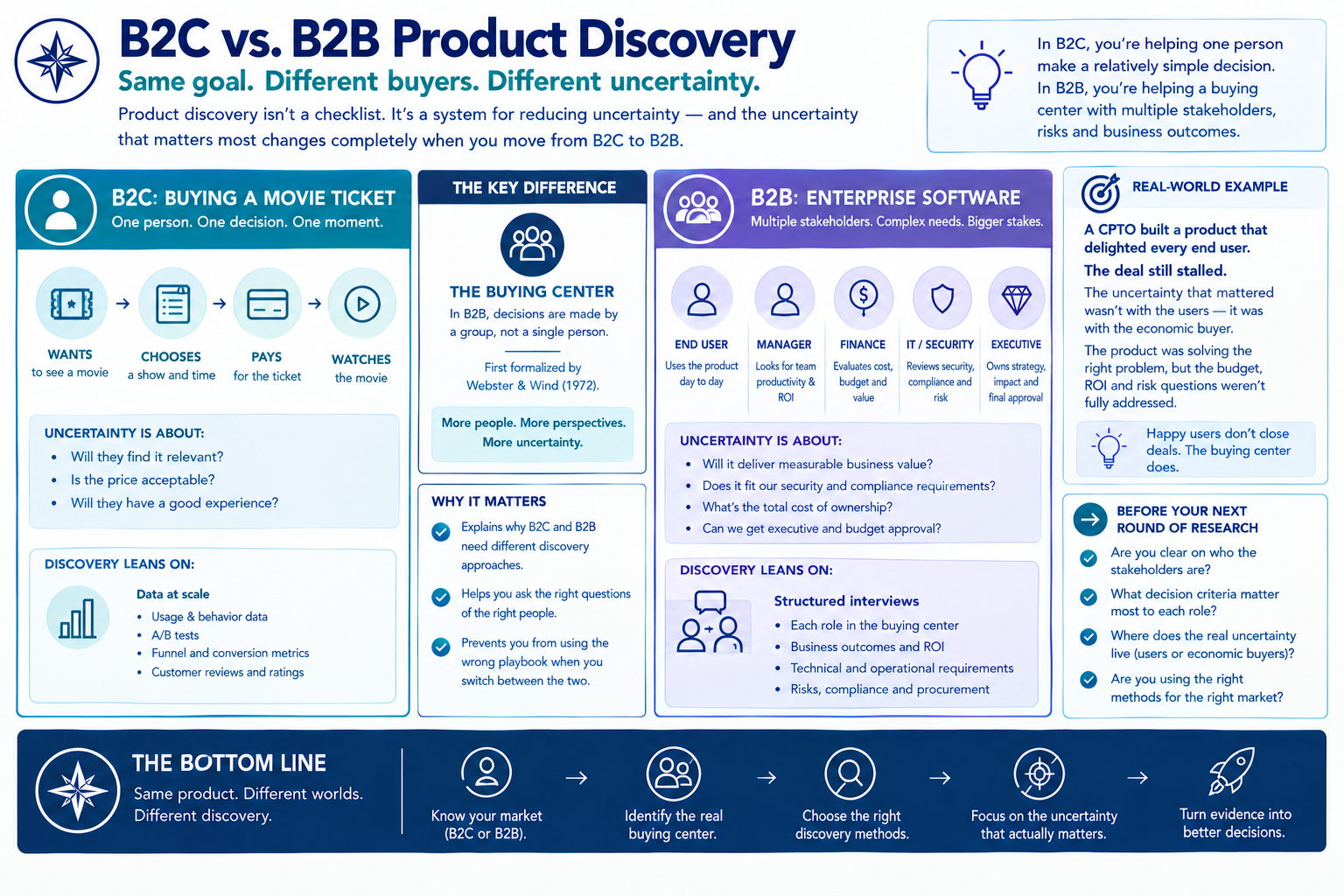
That difference in who is involved changes what discovery looks like day to day. B2C product managers work with a large population of similar users, so they lean on data at scale: usage analytics, A/B tests, funnel data, and customer support patterns, supplemented by direct interviews for depth (Productfolio, “B2C vs. B2B Product Management”). Teresa Torres’s continuous discovery model, built around weekly interviews mapped onto an opportunity solution tree, fits naturally here because the interviewee is often the user, buyer, and decision maker at once, so a single conversation can capture the whole decision (Torres, Continuous Discovery Habits). B2B product managers, by contrast, have far fewer customers and cannot run the same statistical experiments at meaningful scale, so their discovery leans ethnographic: site visits, structured interviews with each role in the buying center, and direct exposure to the workflows a product must fit into (Hustle Badger, “Enterprise Product Management vs. B2C Product Management”). A B2B product manager who only interviews end users will collect excellent usability feedback and still misunderstand why the deal did not close, because the reasons live with a different person entirely. For instance, an end user might praise a workflow feature in every interview while the economic buyer who controls the budget never sees enough return on investment to approve the purchase.
Dave Wascha, a CPTO with experience at Microsoft and Zoopla, described learning this the hard way after building a product that solved every functional problem end users raised and still watched adoption stall. He and his team eventually interviewed chief procurement officers, finance directors, and other economic buyers directly, and built a return-on-investment model those stakeholders could plug their own numbers into (Hustle Badger, “Enterprise Product Management vs. B2C Product Management”). The functional problem had been solved. The economic uncertainty had not, however, and that uncertainty determined whether the contract got signed. That is the trap a B2C-trained product manager falls into most easily: treating end-user delight as the finish line, when in B2B it is often only one input among several that a gatekeeper or economic buyer will still veto.
The reverse mistake happens just as often when a B2B product manager moves into B2C. Enterprise habits favor small numbers of deep, high-touch conversations with named accounts, and that instinct does not scale to a product with millions of users who will never take a sales call. A product manager carrying that instinct into a consumer context tends to over-invest in a handful of loud customers, which crowds out the quantitative signal that reveals what the broader population actually does, and that signal is precisely the data B2C discovery is built to collect cheaply and continuously.
None of this changes the underlying discipline. Discovery in both environments still exists to reduce uncertainty before a team commits engineering effort to a solution. The fundamentals: talking to real people, observing real behavior, and testing assumptions before scaling them, apply equally on both sides. What changes is who holds the uncertainty and what kind of evidence resolves it. In B2C, the population is the challenge, and the tools are built for scale. In B2B, the organization is the challenge, and the tools are built for depth across a small number of roles that do not share the same incentives.
The practical move for a product manager working in either direction is to draw the buying center or user population explicitly before choosing a discovery method, which forces the choice of method to follow from the shape of the uncertainty rather than from habit. Ask who experiences the problem, who uses the solution, who decides, who pays, who can block adoption, and where the value is actually created, and let the answers to those questions determine whether the next step is a large-scale experiment or a small set of structured interviews with the people who can say no.
REFERENCES
Frederick E. Webster and Yoram Wind, “A General Model for Understanding Organizational Buying Behavior,” Journal of Marketing, 36(2), 1972. Referenced for the foundational academic framing of organizational purchases as decisions made by a group of people in distinct roles rather than by a single buyer, the origin of buying-center theory.
Gust de Backer, “Decision Making Unit (DMU): B2B and B2C Buying Center.” https://gustdebacker.com/decision-making-unit. Referenced for the six practical roles in a buying center (end user, influencer, initiator, economic buyer, decision maker, gatekeeper) and the observation that these roles collapse into far fewer people in most consumer purchases.
Productfolio, “B2C vs. B2B Product Management.” https://productfolio.com/b2c-vs-b2b-product-management. Referenced for the contrast between B2C reliance on experimentation tools such as A/B testing at scale and B2B reliance on direct interviews, site visits, and persona-building across multiple stakeholders.
Hustle Badger, Ed Biden, “Enterprise Product Management vs. B2C Product Management.” https://www.hustlebadger.com/what-do-product-teams-do/enterprise-product-management. Referenced for the ethnographic versus data-driven discovery distinction, the Dave Wascha account of misdiagnosing an enterprise adoption problem, and the description of enterprise sales cycles and stakeholder complexity.
Teresa Torres, Continuous Discovery Habits: Discover Products That Create Customer Value. Referenced for the opportunity solution tree model of continuous interviewing, built around a single person who typically holds the user, buyer, and decision-maker roles at once, which is characteristic of consumer discovery.