
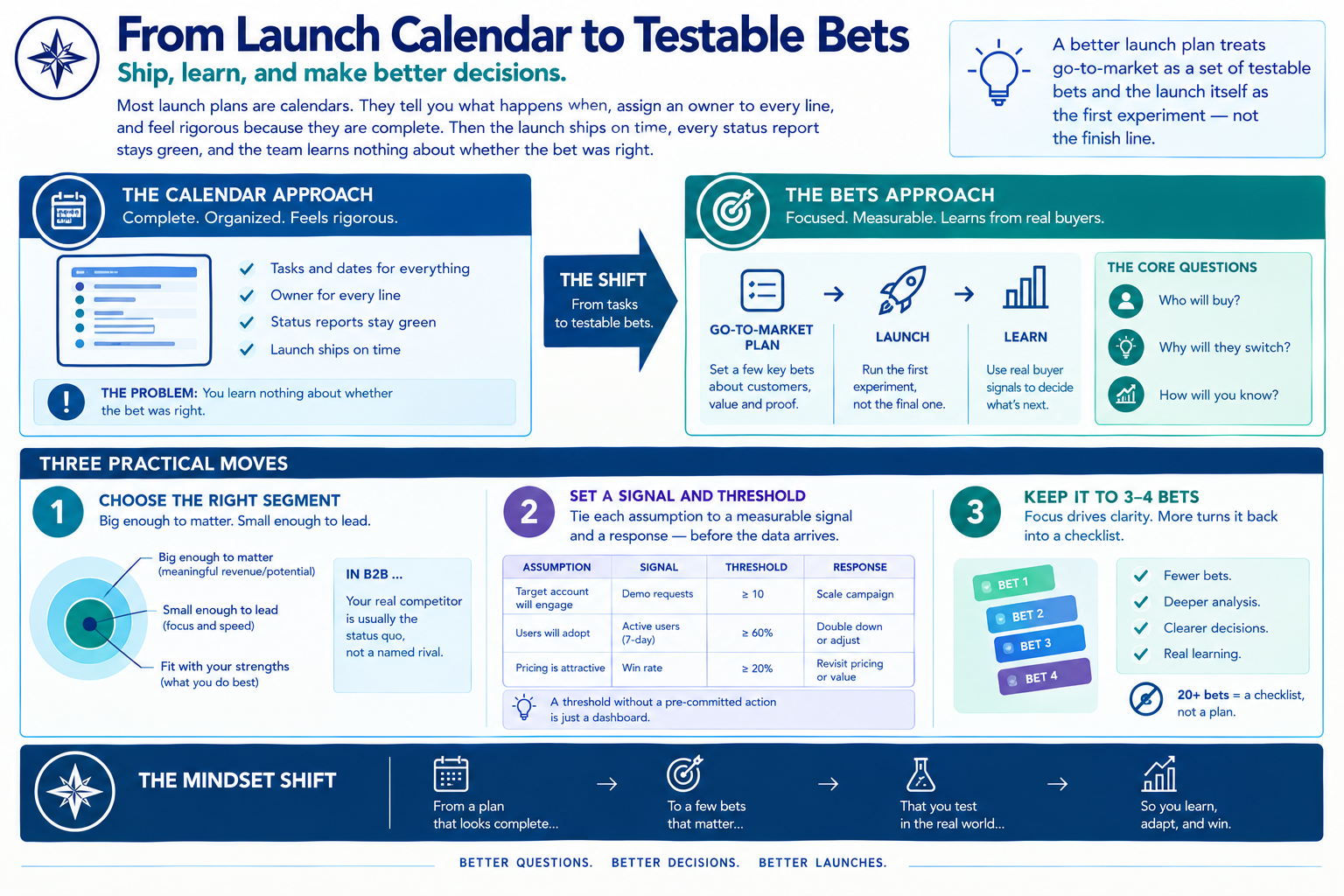
A go-to-market plan is a set of testable bets about who will buy, why they will switch, and how you will know, not a launch-day checklist. Settle those three answers before you pick channels, dates, or messaging, and treat the launch as the first experiment rather than the finish line. The teams that internalize this distinction stop treating a completed task list as evidence of progress, which is why the discipline pays off long before the first dashboard updates.
Is your launch plan a plan, or just a calendar?
Most launch documents answer a single question: what happens when. They sequence the press release, the enablement session, the pricing page, and the webinar, and assign an owner to each line. That structure feels rigorous because it is complete. Every task has a date, and every date has a name. What the document rarely contains, however, is what the team believes about the market and what evidence would prove those beliefs wrong. A calendar tells you what happens when. A plan tells you what you will believe, and what you will do, depending on what comes back.
The distinction matters because every launch rests on assumptions you cannot verify until real buyers respond. You are betting on three things: that a specific segment has the problem badly enough to act, that your message will move them off whatever they use today, and that your channel can reach them at a cost you can afford. Those bets are invisible inside a checklist. A team can execute flawlessly and still learn nothing about whether the bet was right, which is why a launch that ships on time can fail in the market while every status report stays green.
The core concept is the assumption-to-decision link. A launch plan only counts as a plan if each major activity tests a named assumption, and each assumption carries three pre-committed elements: a signal you will watch, a threshold that defines success, and a response you will take if the signal misses. Marty Cagan points out that the four big risks separate value and business viability risk from the more familiar concerns of usability and feasibility (Cagan, 2017). Viability risk is where go-to-market lives: whether the product fits the sales channel, whether you can acquire customers cost-effectively, and whether you can monetize the result. A calendar cannot address those questions. A set of bets can.
Think of two drivers crossing the country. The first has an itinerary: Omaha by six, Denver by four the next afternoon. The second has a destination and a few checkpoints with rules attached: if we have not cleared Nebraska by noon, we skip the Badlands detour, and if the engine runs hot, we stop in the next town. The first driver can hit every stop on time and still arrive with a failing engine they never checked. The second may drift from the original schedule. Every deviation, however, was decided in advance by something they were watching. The itinerary is the calendar. The checkpoints with if-then rules are the plan.
The three bets map onto the questions a go-to-market strategy has to answer. Who will buy is a bet about the segment, and Geoffrey Moore offers a clear version: choose a target that is big enough to matter, small enough to lead, and a good fit with your crown jewels (Moore, 2024). Why they will switch is a bet about positioning, and April Dunford notes that in B2B, vendors typically lose about half their sales opportunities to whatever the prospect already uses (Dunford, 2026). The real competitor is often the status quo, which is why a message that only beats a named rival can still lose the deal. How you will know is a bet about measurement, and it is the hardest of the three.
Measurement is where most teams are weakest. Leading indicators, such as activation rate or sales calls booked, predict future outcomes and let you act before the result is locked, while lagging indicators, such as monthly recurring revenue, only confirm what already happened (Amplitude, 2025). By the time you read last month’s revenue, it is too late to change it. The practical rule is simple: pick leading signals that correlate with the lagging outcome you actually care about, and say out loud which signals you trust at week two and which only mean something at week twelve.
A hypothesis is only a hypothesis if it can be wrong. The discipline of writing falsifiable statements, with a specific change, a predicted outcome, a defined segment, and success criteria set before the test, comes from experiment design and applies directly to launches (Centercode, 2026). Setting thresholds in advance prevents motivated reasoning after the results arrive, because a team that decides what counts as success only after seeing the numbers will always find a way to call the launch a win. For instance, a team might commit in advance that thirty percent weekly usage of a new workflow is a strong result, fifteen to twenty-nine percent means iterate, and anything below fifteen percent means the assumption was wrong.
The failure modes are where the practice earns its credibility, because they are the ways it breaks in real organizations. Write the response before the data arrives: a threshold without a pre-committed action is just a dashboard. Set thresholds you would be embarrassed to move, and if one needs revising, revise it in writing with the reason before the next read. Separate a failed bet from a bad test, because a miss can mean a wrong assumption or a broken measurement, and defining a valid read in advance keeps every miss from being dismissed as noise. Do not bet on everything, because three or four assumptions preserve the discipline while twenty turn the list into the new checklist. Match the signal to the time horizon, since early signals can mislead. Give every pre-agreed response an owner and a decision right, because a response no one can act on is not a response. Keep the stakeholder view simple, so the bets can run underneath a single status color. And plan for hits as well as misses, since a signal far above threshold deserves its own pre-committed response, such as scaling spend or pulling a segment forward.
Three edge cases are worth a sentence each. Some launches are tied to a conference, a contract, or a regulatory deadline, and the date is a constraint rather than a bet, so apply the bets to what you control around it. Low-volume enterprise launches may yield only a handful of data points, so the signal is often qualitative, and the threshold should say so. And when a senior stakeholder owns a particular assumption, pre-commitment is hardest and most valuable, so the conversation belongs before the launch rather than after.
None of this requires abandoning the calendar. It requires subordinating it. Before the next launch kickoff, write down the three or four assumptions the launch depends on, attach a signal and a threshold to each, and decide in advance what you will change if a signal comes back wrong. The timeline still matters. However, it becomes a servant of the bets rather than a substitute for them. The hardest part of a good question is deciding in advance what answer would change your mind, and a launch is no different.
REFERENCES
Amplitude. “Leading vs. lagging indicators, plus examples.” July 28, 2025. https://amplitude.com/blog/leading-lagging-indicators
Cagan, Marty. “The Four Big Risks.” Silicon Valley Product Group, December 4, 2017. https://www.svpg.com/four-big-risks
Centercode. “Product Hypothesis: Write and Test Assumptions (2026 Guide).” January 9, 2026. https://www.centercode.com/blog/product-hypothesis
Dunford, April. “A guide to advanced B2B positioning.” Lenny’s Newsletter, March 10, 2026. https://www.lennysnewsletter.com/p/a-guide-to-advanced-b2b-positioning
Moore, Geoffrey. “Geoffrey Moore on finding your beachhead, crossing the chasm, and dominating a market.” Lenny’s Podcast, January 25, 2024. https://www.lennysnewsletter.com/p/geoffrey-moore-on-finding-your-beachhead
ProductPlan. “Go-to-Market Strategy.” Glossary. https://www.productplan.com/glossary/go-to-market-strategy