
Every product team inevitably faces more ideas than it can pursue. Customers request features, executives promote initiatives, sales teams promise capabilities, engineers suggest improvements, and the market presents new threats and opportunities. In this environment, the ability to assess an opportunity clearly and build a credible business case is one of the most valuable skills a technical product manager can develop. Without this skill, roadmaps become cluttered with whatever is most vocal. An empowered team using this skill can make deliberate choices, defend its decisions to leadership, and avoid the costly practice of building things that no one needs.
An opportunity assessment is a structured approach to determining if an idea deserves further investment before the organization commits engineering resources. Its primary purpose is to ensure clarity early in the process. A good assessment begins by asking what problem is being solved and for whom. Many promising ideas falter at this initial question because the problem is vague, the target customer is unclear, or the pain is real but not urgent enough to compel a change in behavior. A product manager who cannot clearly articulate the specific customer and the specific problem is usually not ready to justify the investment.
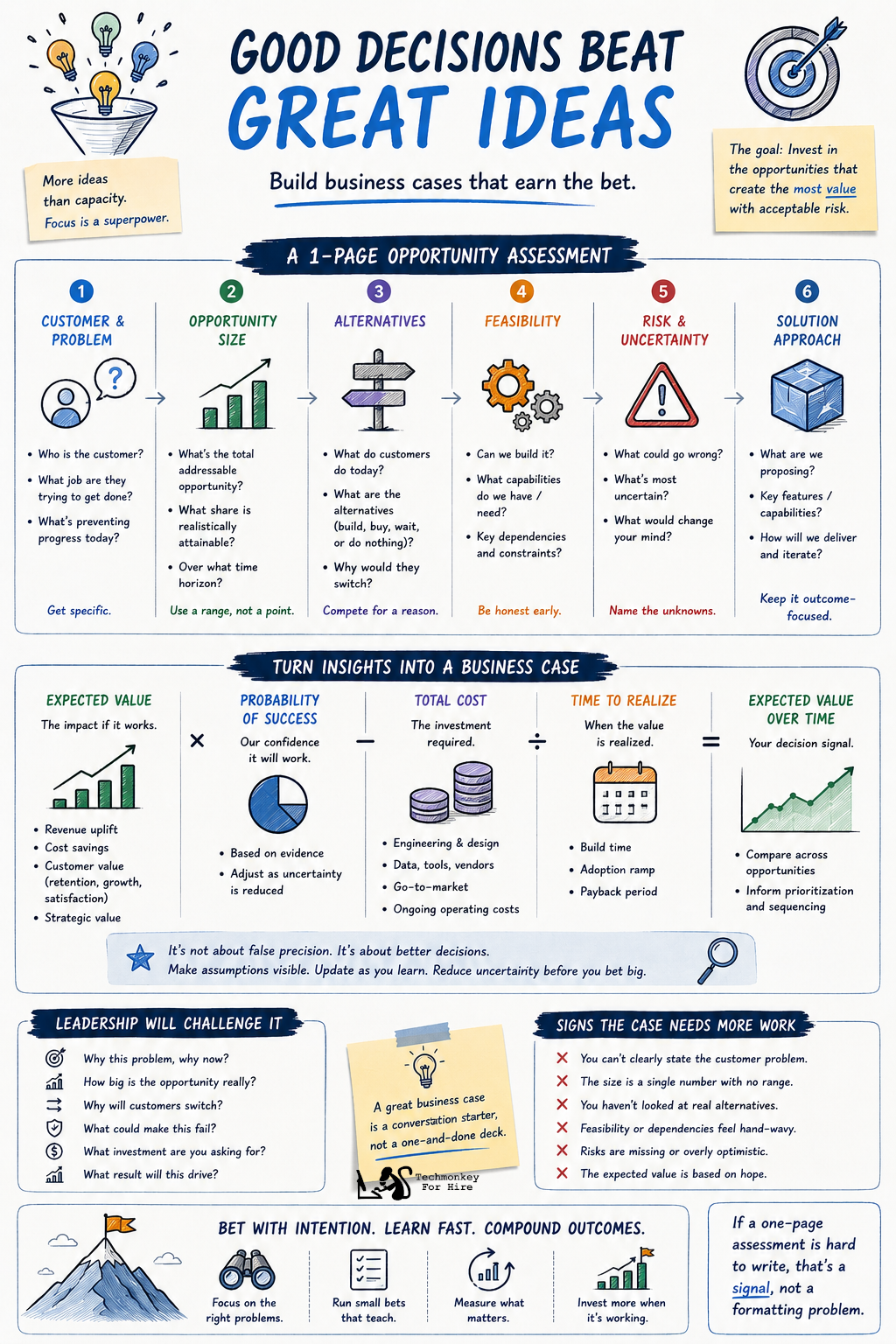
The next question revolves around the size and importance of the opportunity. This does not require a detailed market model at the assessment stage, but it does need a realistic estimate of how many customers experience the problem, how frequently it occurs, how severe it is, and whether solving it aligns with a business objective that the company values. An opportunity can be genuinely useful yet strategically irrelevant. A feature might delight a small number of users while contributing nothing to retention, acquisition, expansion, or differentiation. Part of the discipline is distinguishing between interesting problems and those worth funding.
Features generated by customer requests or problems are simultaneously great development opportunities and the most distracting source of noise for product managers. Customers rarely wait for a product team to solve their issues; they resort to workarounds, spreadsheets, manual processes, competitor tools, or internal scripts. Understanding these alternatives reveals the true strength of demand and sets the bar for a new solution. If customers have tolerated the problem for years using a simple workaround, the team should be skeptical that a new feature will alter their behavior. Conversely, if customers are cobbling together costly, fragile solutions, that urgency signals a stronger need.
Feasibility and risk also deserve equal attention, especially for technical products. A product manager should consider whether the solution relies on data the company does not possess, on unreliable integrations, on an architecture that would require substantial rework, or on operational capabilities the team cannot yet support. Marty Cagan’s opportunity assessment approach encourages teams to address foundational questions about business objectives, the problem, the target market, and how success will be measured before committing to a solution. This framework helps prevent teams from becoming too attached to a solution before ensuring it is desirable, viable, feasible, and appropriate for the business.
When an opportunity successfully passes the initial assessment, it requires a business case to justify a significant investment. A business case translates the opportunity into terms that executives use to allocate resources: expected value, cost, risk, and timing. It represents the intersection of product judgment and financial reasoning. The objective is to make the investment logic clear and testable. A credible business case clearly states its assumptions, allowing others to challenge them, as assumptions are often where business cases succeed or fail.
The core of most business cases is a comparison of expected benefits against expected costs over time. Benefits may include new revenue, expansion revenue, improved customer retention, reduced churn, lower support costs, faster sales cycles, or decreased operational risk. On the other hand, costs encompass engineering efforts, design, ongoing maintenance, infrastructure, support, and the opportunity cost of not pursuing alternative projects. Techniques such as cost-benefit analysis, return on investment, and net present value help teams evaluate whether an investment is worthwhile and how it compares to alternatives. For advanced use of MBA principles, net present value is important because a dollar of benefit received next year is worth less than a dollar received today, and many product investments incur costs now while delivering value later.
One of the most common mistakes in business cases is overstating benefits while understating costs. Enthusiastic teams may assume high adoption rates, rapid revenue growth, and smooth execution while overlooking challenges such as integration friction, change management issues, support burdens, and the long-term maintenance needs. A more robust approach is to model conservative, expected, and optimistic scenarios while identifying which assumptions most significantly influence the outcome. If the entire business case depends on converting a large percentage of free users to paid plans, that single assumption should be supported by evidence rather than mere optimism. Conducting sensitivity analysis, even a simple version, helps leadership understand where the real risks lie.
A good business case also addresses uncertainty honestly. Early-stage opportunities rarely justify heavy investments based solely on precise numbers, since such figures are often educated guesses. In such cases, the business case should propose a smaller investment to reduce uncertainty, such as creating a prototype, conducting a limited release, running a pricing experiment, or undertaking a discovery effort. This staged approach protects the company from making large bets on unproven assumptions and gives the team a way to earn the right to invest more. Presenting investment as a series of decisions rather than a single commitment distinguishes a disciplined product organization from one that fluctuates between big bets.
Effective communication is just as important as thorough analysis. The most compelling business cases tell a clear story: they outline the customer problem, explain its significance to the business, quantify the opportunity size, present the main alternatives, indicate the proposed solution direction, disclose the anticipated costs, estimate the expected value, identify the biggest risks, and describe how the team will learn whether their approach is correct. When the narrative is coherent, executives can engage with the real trade-offs rather than getting lost in spreadsheet details.
For technical product managers, opportunity assessment and business case development are tools for making better product decisions and for earning organizational trust. They connect customer problems to business value, force clarity on assumptions, expose risks before they become expensive, and give leadership a defensible basis for allocating scarce resources.
As an exercise for the dedicated reader, your next step is to take one idea currently competing for roadmap space and write a one-page assessment that identifies the customer, the problem, the opportunity size, the alternatives, the feasibility risks, and how success will be measured. If that single page is hard to write, it signals that the opportunity requires greater understanding before it warrants further investment.
REFERENCES
Marty Cagan, Silicon Valley Product Group, Assessing Product Opportunities. https://www.svpg.com/assessing-product-opportunities
Silicon Valley Product Group, Lean Canvas vs. Opportunity Assessment. https://www.svpg.com/lean-canvas-vs-opportunity-assessment
Harvard Business School Online, What Is Cost-Benefit Analysis? A 4-Step Process. https://online.hbs.edu/blog/post/cost-benefit-analysis
Investopedia, Cost-Benefit Analysis: Usage, Advantages, and Limitations. https://www.investopedia.com/terms/c/cost-benefitanalysis.asp
Votito, Product Opportunity Assessment: A 10-Question Reference Guide. https://www.votito.com/methods/product-opportunity-assessment