
Outcome-driven roadmapping is a response to a familiar product management failure: teams ship what they promised, but the business result does not change. A feature appears on time, the roadmap looks complete, and the release notes are impressive, yet activation remains weak, retention does not improve, sales still struggles to explain differentiation, or support tickets keep rising. The problem is not that roadmaps are useless. The problem is that many roadmaps become lists of outputs rather than instruments for changing customer and business outcomes.
A traditional feature roadmap tends to answer the question, “What will we build and when?” An outcome-driven roadmap asks a more valuable question: “What change are we trying to create, and what bets might produce it?” That difference matters because modern product work is uncertain. A product team may believe a new onboarding flow will improve activation, a new integration will increase enterprise conversion, or a new analytics module will improve retention. Treating the feature as the commitment can lock the team into a solution before it has learned whether the solution is the right one.
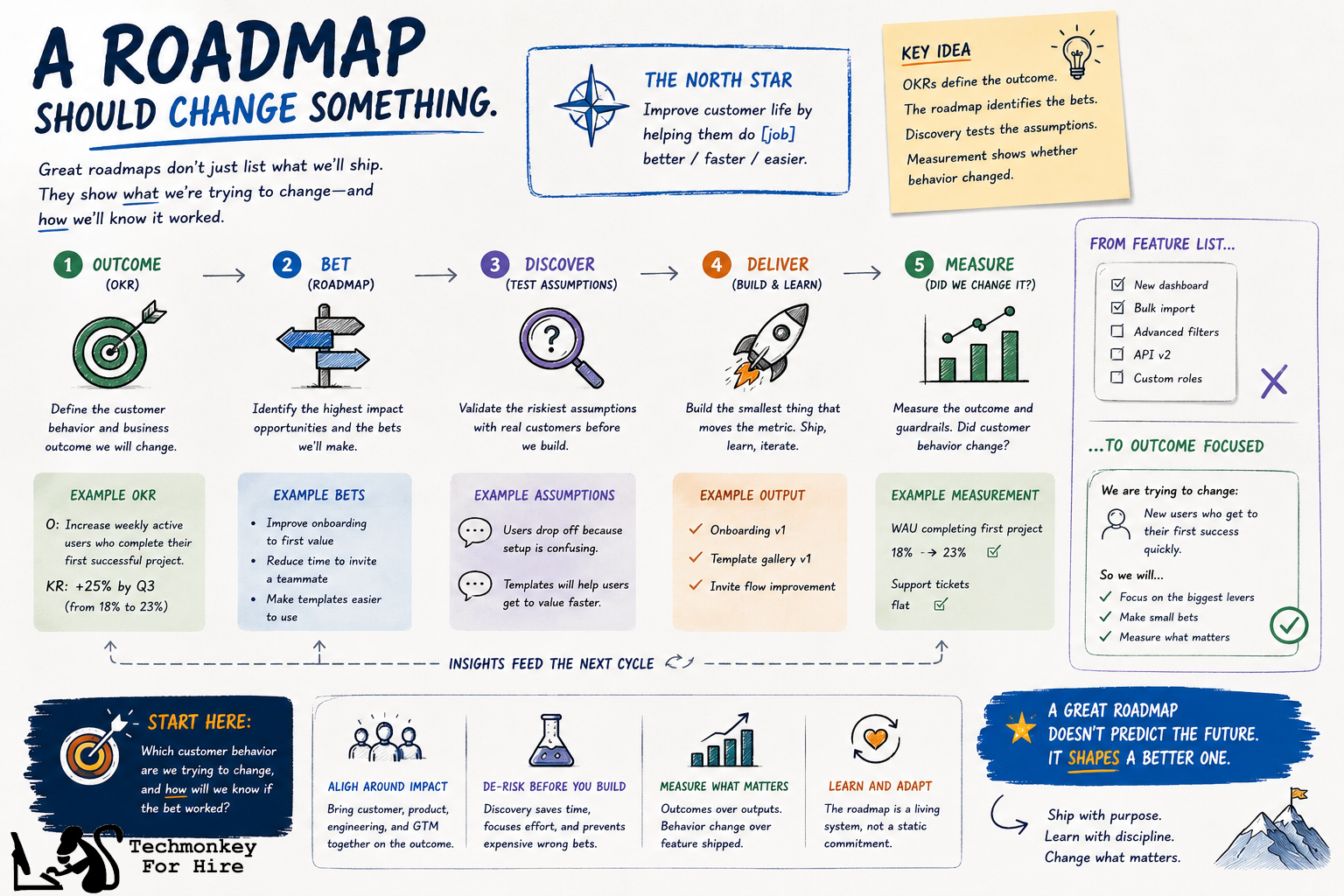
Objectives and Key Results (OKRs) can help when they are used as a bridge between strategy and product learning. The objective should describe a meaningful direction, such as making new customers successful faster or improving trust in a workflow that affects renewal. The key results should describe measurable signals of progress, such as a higher percentage of accounts reaching the first value within 7 days, a shorter time-to-complete for a critical task, improved retention in a target segment, or fewer support escalations after a workflow change. The strongest OKRs define what success would look like if the roadmap choices are working.
The challenge is that OKRs are often used incorrectly. Sometimes objectives are too vague, or the key results derived from them are just project milestones. “Launch new reporting dashboard” is not a strong key result because it describes delivery rather than effect. “Increase weekly active use of reporting by finance administrators from 32% to 45% while maintaining query performance under two seconds” is closer to an outcome because it names a user group, a behavior, a measurable change, and a quality guardrail. This level of specificity forces the team to connect product decisions with real adoption rather than internal completion.
An outcome-driven roadmap does not mean features disappear. Product teams still need to make commitments, sequence engineering work, coordinate dependencies, and communicate plans. The difference is that features become hypotheses within a broader outcome narrative. A roadmap might say that the team is pursuing faster enterprise onboarding and is exploring three bets: simplifying permission setup, creating a guided data import flow, and adding administrator progress visibility. Each bet has different assumptions, design implications, and technical dependencies. The roadmap becomes a learning plan, not just a delivery calendar.
This approach also changes stakeholder conversations. Executives often want certainty because they need to manage revenue expectations, customer commitments, and resource allocation. Sales teams want to know what they can promise. Engineering wants stable priorities. Customer success wants relief from recurring customer pain. An outcome-driven roadmap gives each group a clearer way to engage. Instead of arguing only about whether a feature is “in” or “out,” the conversation can focus on whether the desired outcome is still the right one, which customer segment matters most, what evidence supports the next bet, and what tradeoffs the organization is willing to make.
For technical product managers, outcome-driven roadmapping requires fluency in both product evidence and delivery reality. It is not enough to declare a metric and ask engineering to find a way. The PM must understand whether the desired outcome depends on architecture, data quality, workflow redesign, API reliability, permissions, latency, migration work, or operational enablement. A team may want to reduce onboarding time, but the bottleneck might be an integration approval process rather than the user interface. A team may want to improve retention, but the real barrier might be incomplete data, weak notification logic, or poor administrator controls. Outcomes become useful when the team understands the system that produces them.
Quarterly or yearly OKRs can set direction, but product teams need more frequent checkpoints to inspect whether their bets are producing evidence. A monthly outcome review can examine leading indicators, customer feedback, experimental results, technical risks, and changes in the market context. The purpose is to prevent a roadmap from continuing unchanged after the evidence has changed. If a bet is not moving the target metric, the team should be able to adjust the solution while staying committed to the outcome. If the outcome itself no longer matters, leadership should be willing to change the objective rather than quietly keep funding irrelevant work.
A common mistake is choosing metrics that are too far from the team’s influence. Revenue is important, but many product teams cannot move revenue directly within a quarter without help from pricing, marketing, sales, implementation, and customer success. Better product key results often focus on customer behaviors that are credible leading indicators of business value. For example, a collaboration product might track the percentage of teams that invite three or more active collaborators within the first week. A security product might track successful policy configuration without support intervention. A data product might track repeat use of a saved workflow by a target persona. These metrics are not perfect, but they are closer to the product experience the team can improve.
Outcome-driven roadmapping also requires discipline around non-goals. If a team is serious about improving activation for mid-market customers, it may need to defer advanced configuration features for large enterprises. If the objective is to improve reliability for existing customers, the team may need to pause new acquisition-oriented features. Strategy becomes real when the roadmap says no. OKRs can make those tradeoffs visible because they remind the organization that focus is not about doing less work; it is about concentrating effort where it can create measurable change.
Mature and empowered product teams treat roadmaps and OKRs as connected management tools. The OKR defines the change that matters. The roadmap identifies the bets most likely to create that change. Discovery tests whether the bets are valid. Delivery turns selected bets into usable product improvements. Measurement shows whether behavior actually changed. Leadership reviews decide whether to continue, adjust, or stop. When this loop works, the roadmap becomes more credible because it is anchored in outcomes, and OKRs become more useful because they are connected to real product choices.
As an exercise for the dedicated reader, review the current roadmap and mark every item as either an outcome, a bet, a dependency, or an output. If most items are outputs, the team may be managing activity rather than impact. Then choose one roadmap area and rewrite it around a specific customer behavior, a business reason that behavior matters, a small set of solution bets, and two or three measurable signals. That exercise can transform a roadmap conversation from “What are we shipping?” to “What are we trying to change, and how will we know if it is working?”
REFERENCES
Roman Pichler, How to Get Started with Outcome-Based Product Roadmaps. https://www.romanpichler.com/blog/how-to-get-started-with-outcome-based-product-roadmaps
Product Talk, Product Roadmaps: How the Best Product Teams Plan for Uncertainty. https://www.producttalk.org/product-roadmaps
Google re:Work, Set Goals with OKRs. https://rework.withgoogle.com/intl/en/guides/set-goals-with-okrs
What Matters, Google’s OKR Playbook. https://www.whatmatters.com/resources/google-okr-playbook
Atlassian, OKRs: The Ultimate Guide to Objectives and Key Results. https://www.atlassian.com/agile/agile-at-scale/okr