
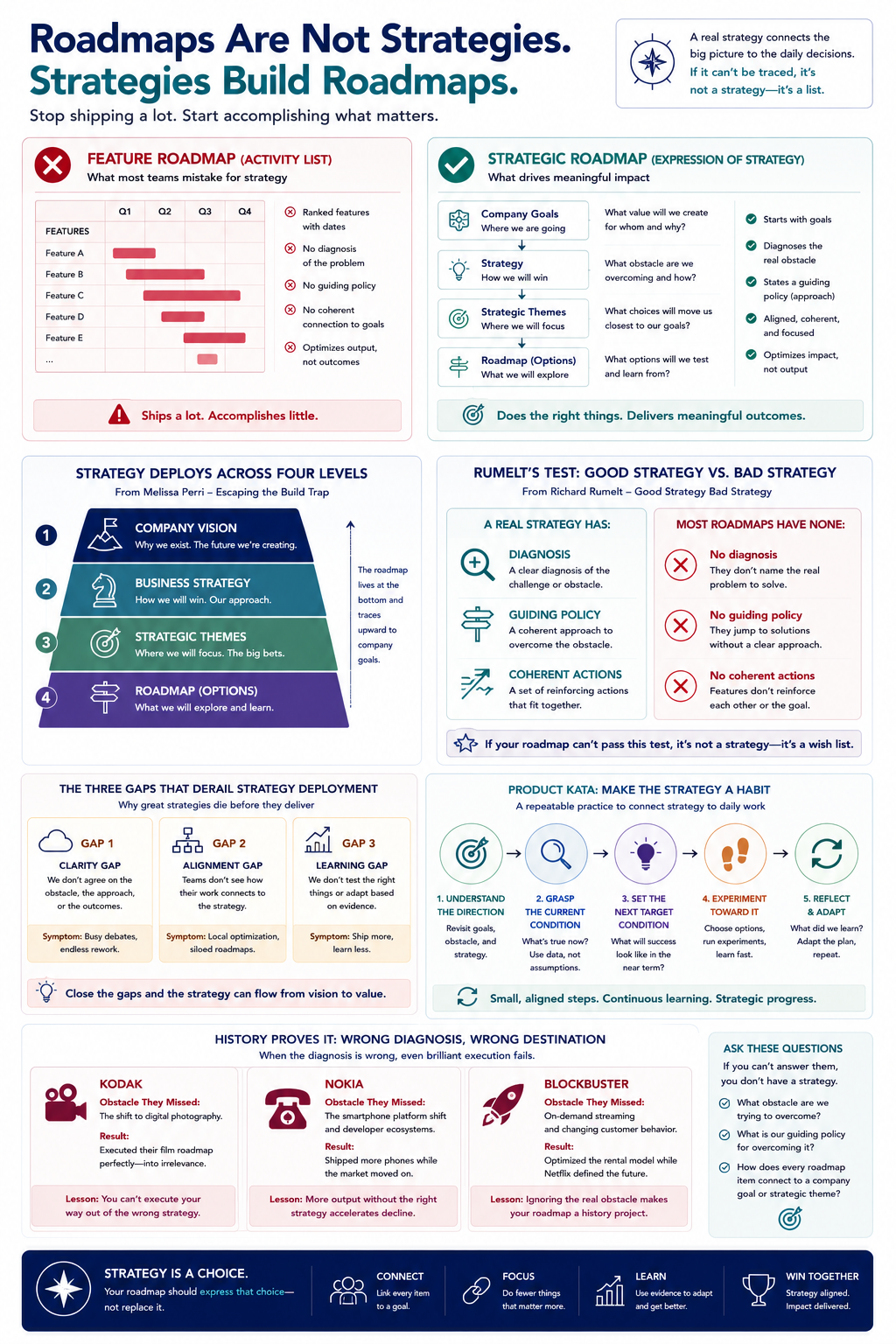
Product organizations often confuse a roadmap with a strategy. You cannot “win the market” with a ranked list of features tied to release dates. A roadmap is a communication artifact that shows what the team intends to build and roughly when. A strategy is an argument about how a specific set of actions will overcome a specific obstacle to reach a desired outcome. The two operate at different levels of abstraction, serve different audiences, and fail in different ways. When teams collapse them together, they fall into what Melissa Perri calls the build trap: measuring success by outputs shipped rather than outcomes achieved.
Richard Rumelt, in Good Strategy Bad Strategy, writes that strategy is “coherent action backed by an argument.” Most documents labeled strategy lack this depth and are just a mix of financial targets and activity lists. Rumelt identifies four hallmarks of bad strategy: fluff, failure to face the challenge, mistaking goals for strategy, and bad strategic objectives. A feature roadmap that lists what to build without naming the obstacle it addresses, without a guiding policy for how to address it, and without coherent actions that reinforce each other, fits Rumelt’s diagnosis of bad strategy almost exactly. The roadmap is the activity list. The strategy is the argument that makes the activity list make sense.
The connection to company strategy is where most product teams lose the thread. Perri, in Escaping the Build Trap, describes strategy deployment as a set of interconnecting narratives told at different levels of the organization, each on a different time scale. Executives think in terms of a five- to ten-year vision. Supporting this vision are strategic intents: large, outcome-oriented goals that typically take one to five years to complete and aim to identify the business challenges standing in the way of the vision. Below strategic intents sit product initiatives, which translate business challenges into user problems the product can address. Below product initiatives sit options, the different ways a team might solve those problems. A roadmap belongs at the options level. It is the output of teams working through how to reach a goal, and it should trace upward through product initiatives and strategic intents to the company vision. When that tracability is missing, the roadmap floats free of the business, and shipping features becomes its own justification.
Rumelt’s kernel of good strategy gives product leaders a practical test for whether their roadmap is grounded. The kernel has three parts: a diagnosis of the situation, a guiding policy for handling it, and coherent actions that follow. A diagnosis explains the challenge, simplified to the aspects that matter most. A guiding policy is an overall approach for dealing with the obstacles the diagnosis identified, like guardrails that direct and constrain action without specifying every move. Coherent actions are coordinated steps that implement the policy and reinforce each other. A feature roadmap with no diagnosis has no way to be evaluated, because there is no benchmark for whether the proposed work is the right work. A roadmap with a diagnosis but no guiding policy becomes a list of disconnected tasks. A roadmap with diagnosis and policy but incoherent actions is a to-do list pretending to be a strategy. The cost of building the wrong thing for a year dwarfs the cost of a week spent getting the diagnosis right.
The gaps that Perri borrows from Stephen Bungay’s The Art of Action explain why even a good strategy degrades into a feature factory during deployment. Bungay identifies three gaps between plans, actions, and outcomes. The knowledge gap is the difference between what management wants to know and what the company actually knows. The alignment gap is the difference between what people do and what management wants them to do. The effects gap is the difference between what we expect actions to achieve and what actually happens. The common reflex is to close these gaps with more control: more detailed specs, tighter deadlines, more mandated features. Bungay and Perri argue the opposite. Close the knowledge gap by asking for just enough information to make a decision. Close the alignment gap by letting each level define how it will achieve the intent of the level above, rather than sending mandates down. Close the effects gap by giving teams freedom to adjust their actions to meet goals, rather than adding controls when results disappoint. A roadmap built on this logic is flexible by design. It communicates direction and current stage, and it changes as the team learns.
Perri’s Product Kata operationalizes this at the team level. It is a four-step problem-solving loop. First, understand the direction: the company vision, the strategic intent, and the product initiative. Second, analyze the current state of the initiative and the product. Third, set the next goal, an outcome the team can measure on a short time scale. Fourth, choose the next step of the product process: problem exploration, solution exploration, or solution optimization. The Kata forces teams to fall in love with the problem before committing to a solution, and it keeps the roadmap tied to a measurable outcome rather than a delivery date. When a team can articulate the goal, the current state, the obstacle, and the expected result of the next move, the roadmap becomes a living expression of strategy rather than a fixed commitment.
Rumelt’s historical examples make the stakes concrete. International Harvester, in 1979, produced a strategic plan spanning hundreds of pages that projected market share growth and profit improvements. The plan never mentioned the company’s worst-in-industry labor relations or its grossly inefficient factories, the actual obstacles it faced. Within a few years, Harvester collapsed and was broken up. The plan was extensive and detailed and addressed none of the things that mattered. The lesson for product teams is direct: a roadmap that ignores the real obstacle, whether that obstacle is churn, onboarding friction, or a competitive shift, is a Harvester-style plan. It will look impressive in review and fail in the market. Rumelt’s Nvidia example shows the kernel working. In 1995, Nvidia diagnosed that it was losing the performance race. Its guiding policy was to release a faster, better chip three times faster than the industry norm. Its coherent actions were to form three development teams on overlapping schedules, invest in simulation to avoid fabrication delays, and reclaim driver development from board makers. Each action tied to the policy, the policy tied to the diagnosis, and over the following decade Nvidia moved from struggling startup to industry dominant.
As an exercise for the motivated reader, start with Rumelt’s diagnosis: name the obstacle in plain language. Define a guiding policy: the approach that makes the actions coherent. Then let Perri’s framework deploy that strategy through vision, strategic intents, product initiatives, and options, with the roadmap appearing at the options level and tracing upward. Use Product Kata to keep the team anchored to outcomes, and use Bungay’s gaps to resist the temptation to add control when results lag. A roadmap built this way changes as the team learns, connects every feature to a company-level goal, and gives leadership visibility into progress without pretending that a list of features is a plan for winning. That is the difference between a strategy and a feature roadmap.
REFERENCES
Perri, Melissa. Escaping the Build Trap: How Effective Product Management Creates Real Value. O’Reilly Media, 2018. Key concepts referenced: the build trap (measuring outputs over outcomes), strategy deployment across four levels (vision, strategic intent, product initiatives, options), strategic intents as one- to five-year outcome-oriented goals, Product Kata four-step problem-solving loop, and the three gaps (knowledge, alignment, effects) adapted from Stephen Bungay’s The Art of Action. Summary source: Andrew Clark, “Book Review and Summary: Escaping the Build Trap by Melissa Perri,” andrewclark.co.uk, https://andrewclark.co.uk/product-book-summaries/escaping-the-build-trap. Additional summary source: Craig McCaskill, “Escaping the Build Trap,” craigmccaskill.com, https://craigmccaskill.com/escaping-the-build-trap.
Rumelt, Richard P. Good Strategy Bad Strategy: The Difference and Why It Matters. Crown Business, 2011. Key concepts referenced: the strategy kernel (diagnosis, guiding policy, coherent actions), the definition of strategy as “coherent action backed by an argument,” the four hallmarks of bad strategy (fluff, failure to face the challenge, mistaking goals for strategy, bad strategic objectives), the International Harvester 1979 case, the Nvidia 1995 turnaround case, and the quote on identifying and analyzing obstacles. Summary source: Henrik van der Pol, “Book Review: Good Strategy / Bad Strategy,” Perdoo, https://www.perdoo.com/resources/blog/book-review-good-strategy-bad-strategy-by-richard-rumelt. Additional summary source: Aydoo, “Good Strategy Bad Strategy: Rumelt’s Diagnosis Framework,” https://www.aydoo.services/en/articles/good-strategy-bad-strategy.
Bungay, Stephen. The Art of Action: How Leaders Close the Gaps Between Plans, Actions, and Results. Brilliance Audio, 2011. Referenced via Perri’s adaptation in Escaping the Build Trap for the knowledge gap, alignment gap, and effects gap framework and the definition of strategy as a deployable decision-making framework.