
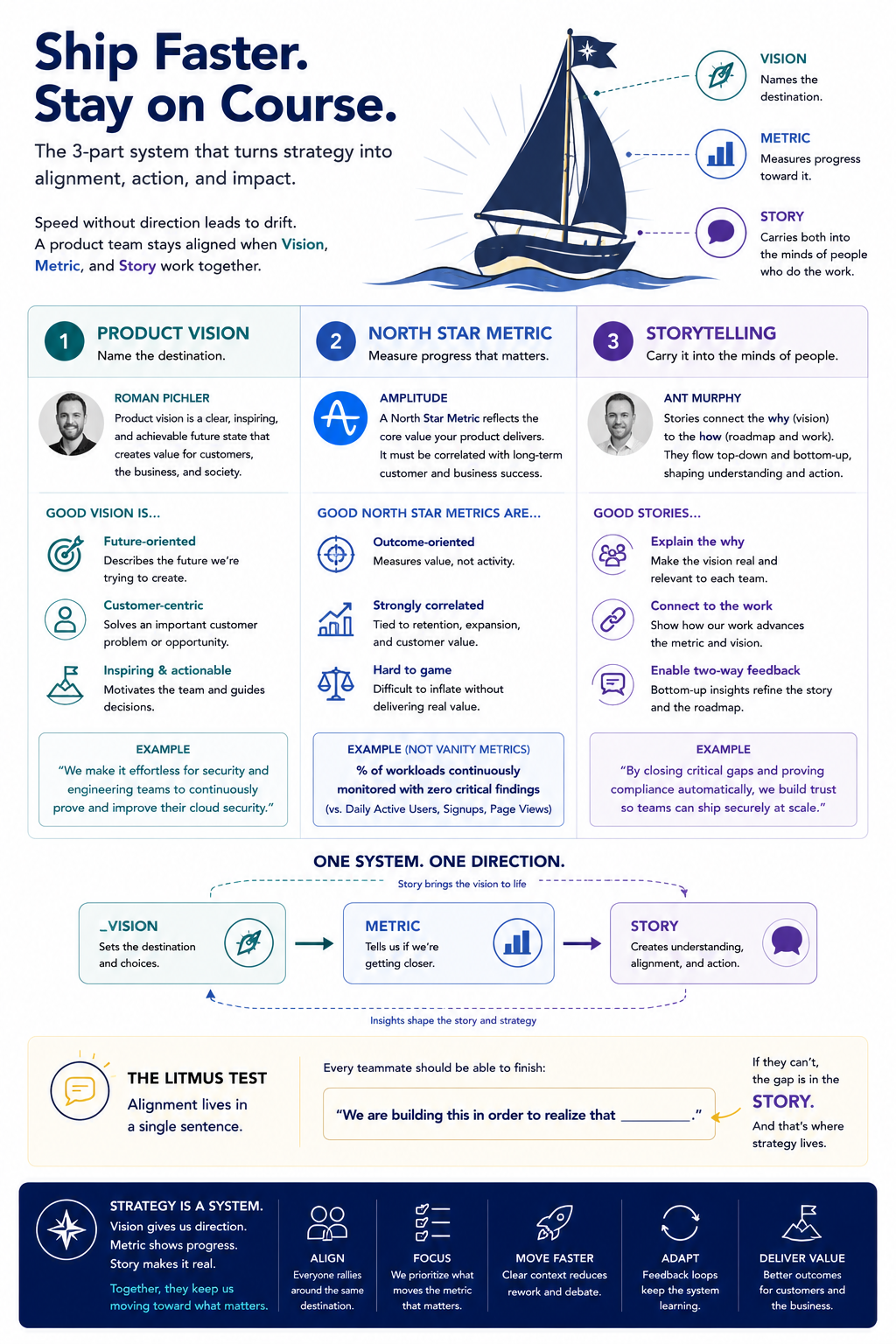
A product team can build faster, ship more often, and still drift in the wrong direction. Teams need a clear product vision, a measurable north star metric, and a method to communicate this vision. Vision sets the long-term destination, the north star metric turns that destination into something measurable, and storytelling carries the strategy from a document into the minds of engineers, executives, and customers.
A product vision describes the future state a team wants to create and usually looks ahead three to five years. Roman Pichler frames the vision as the reason a product exists and the change it aims to bring about for its users and the business. A strong vision is ambitious enough to inspire yet specific enough to guide decisions. It defines which problems matter and which ones do not. Without a vision, a roadmap becomes a queue of disconnected features, and prioritization turns into a contest of whoever argues loudest. A clear vision gives the team a reference point for every tradeoff, which keeps the product coherent as it evolves.
A vision is far too high-level to guide a team week to week or sprint to sprint. That level of resolution requires metrics to guide the team toward the farther-out vision target. That gap is solved by a north star metric. Amplitude, which has operationalized the North Star Framework across hundreds of companies, defines the north star metric as the single measure that best captures the value customers derive from a product. It sits between the customer problem the team is solving and the revenue the business earns by solving it. This serves three purposes at once. It gives the organization clarity and alignment on what to optimize. It communicates product impact to the rest of the company. And it holds the team accountable for an outcome rather than for shipping volume.
A good north star metric has three characteristics. It aligns to customer value. This means it reflects an action that creates real value for the user rather than a vanity count such as daily active users or registered accounts. It represents product strategy, which means a reader can infer the company’s strategy from the metric itself. Finally, it is a leading indicator of success, which means it moves ahead of revenue and predicts future outcomes. Amplitude offers concrete examples. A Fortune 100 retailer growing mobile commerce chose “number of mobile orders delivered,” because that single phrase captures ordering from the app, a completed delivery, and a good experience without payment or logistics problems. Facebook in its early days chose “users adding seven friends in the first ten days,” because that behavior predicted long-term engagement.
Amplitude also stresses that a company should usually have one north star metric, supported by three to five inputs the team can directly influence. Those inputs often map to breadth, depth, frequency, and efficiency. These are the dimensions along which a product creates value. For example, a grocery delivery app might break its north star into the number of customers placing orders, the breadth of items per order, the frequency of orders, and the efficiency of fulfillment. This tree lets every team see how its work rolls up to the same number. This turns a metric into a coordination mechanism with teams to keep the vision in sight during the minutiae of development.
Selecting the right north star begins with understanding which game the product plays. Amplitude groups digital products into three games. The attention game measures how much time users spend, which applies well to media and social products. The transaction game measures how many transactions users complete, which applies to commerce and marketplaces. The productivity game measures how efficiently users get work done, which suits B2B tools. Facebook and Netflix both play the attention game, but their models differ so sharply that Facebook optimizes feed engagement while Netflix optimizes subscriber growth. Picking the game forces a team to focus.
The third element of storytelling is the one most product teams neglect. A vision and a metric are only useful if people understand and believe them, and that requires storytelling. Ant Murphy argues that most product managers already have good stories but fail to package them in a structure that drives impact. He offers a top-down and bottom-up narrative that connects vision to roadmap in either direction. Top-down reads: to realize the vision, our strategy is this; we will start by focusing on this outcome, by solving this opportunity, through building this feature. Bottom-up reverses it, so a team can explain why a single feature matters by tracing it back up to the vision. This structure lets a product manager answer the what, the why, and the how in one breath.
For framing an opportunity, Murphy uses a compact formula of data, problem, diagnosis, and proposed solution. A statement such as five thousand users a month abandon items in their cart, which causes this pain, which I believe happens for this reason, so I propose this fix, becomes a small but complete story. It leads with evidence, names the problem, states the assumption, and ends with a recommendation. That structure is hard to argue with because it is an argument. For regular product updates, he uses a past, present, future format that carries stakeholders through what shipped and how it performed, what the team is doing now, and what comes next. For day-to-day incidents and wins, he uses the STAR structure of situation, task, action, and result.
The practical takeaway is to treat vision, north star, and narrative as one system. As an exercise for the reader, write a vision that names the future you want to build. Choose a single north star metric that reflects customer value and predicts revenue, then break it into three to five inputs the team can move. Connect the two with a top-down and bottom-up story so every team member can explain how this quarter’s work serves the long-term destination. If a teammate cannot finish the sentence “we are building this in order to realize that,” the gap is in the story, and the story is where the strategy actually lives.
REFERENCES
Amplitude, Every Product Needs a North Star Metric: Here’s How to Find Yours. https://amplitude.com/blog/product-north-star-metric
Roman Pichler, Product Vision FAQs. https://www.romanpichler.com/blog/ultimate-product-vision-faqs
Ant Murphy, Why Most Product Managers Aren’t Great Storytellers. https://www.antmurphy.me/newsletter/story-telling-for-product-managers
Amplitude, What Makes a Good vs Bad North Star Metric. https://amplitude.com/blog/good-bad-north-star-metric
Userpilot, What Product Vision Actually Is (4 Frameworks for Writing One). https://userpilot.com/blog/product-vision-examples