
Most digital products fail to grow for reasons that have little to do with the code or implementation. The team never decided exactly who the product is for and why that group should choose it over the alternatives. Segmentation, targeting, and positioning, collectively known as the STP framework, is the discipline that drives those decisions. Philip Kotler introduced STP in 1969 as the essence of strategic marketing, and it remains a staple because it puts customer needs ahead of product features. For technical product managers, STP connects the roadmap to the market by answering three questions in sequence: who are the distinct groups of users, which group will we serve, and why will they pick us.
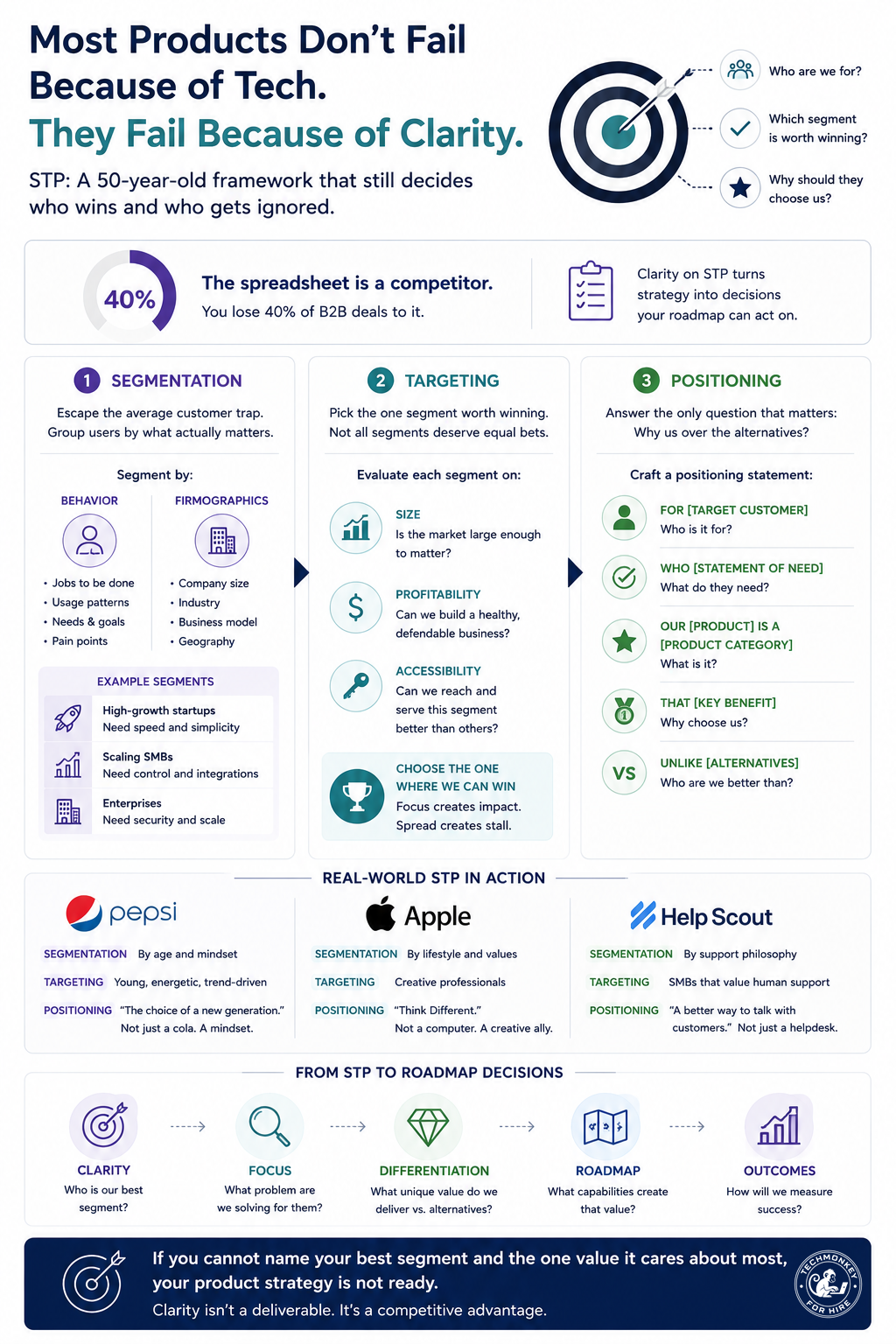
Segmentation is the work of dividing a broad market into groups that behave differently. The goal is to escape the average-customer mindset, because designing for the average usually results in a product that serves no one well. In consumer products, segments are commonly built from four layers of data: demographics such as age and income, geography such as country or city, psychographics such as values and risk tolerance, and behavior such as purchase history and product usage. Digital products have an advantage here, since usage data, funnels, and cohorts reveal behavioral segments that surveys never capture. A team can see which users activate quickly, which return weekly, which churn after a single session, and those patterns often matter more than demographics.
In B2B software, segmentation usually starts with firmographics such as company size, revenue, and industry, then sharpens into something far more actionable. April Dunford, who has worked on positioning with more than 200 companies, including Google, IBM, and Postman, describes a strong B2B segment in concrete terms: for example, creative agencies of three or more people that fit a specific profile, have a defined budget, and already use a particular tool. The tighter the segment, the more effective the go-to-market effort, especially because enterprise purchases often involve 5 to 7 decision-makers. Segmentation should also be separated from personas. A segment describes the type of account to pursue, while a persona describes the individual champion within that account who builds internal consensus and gets the deal done.
Targeting is the decision that follows segmentation, and it is where discipline is tested. Chasing every segment spreads a limited budget too thin and weakens the product’s identity. A practical way to choose is to evaluate each segment against three criteria: size, meaning whether it is large enough to generate meaningful revenue; profitability, meaning whether lifetime value justifies the cost of acquisition; and accessibility, meaning whether the team can actually reach and serve that group. Pepsi offers a classic example of disciplined targeting. During the cola wars of the 1980s, it recognized that converting loyal Coke drinkers was futile, so it focused on switchers who bought both brands and positioned itself as the choice of a new generation. That focus paid off when Coca-Cola stumbled with New Coke.
Positioning is the final step and the one that ties everything together. It defines the clear and desirable identity a product holds in the mind of the target customer, and it answers the only question that matters to a buyer: why choose us over the alternatives? April Dunford defines positioning as being the best in the world at delivering value that a well-defined set of customers care deeply about. Her methodology moves through five components. First, identify the competitive alternatives, meaning what a customer would do if the product did not exist. This includes the status quo, where roughly 40% of deals are lost. The real competition is ingrained behaviors like a spreadsheet, pen and paper, or an intern. Second, list the unique attributes the alternatives lack. Third, translate those attributes into the value they create. Fourth, identify the customers who care most about that value. Fifth, choose the market context that makes the value obvious to those customers.
The Help Scout case shows how this works in practice. The company’s real differentiation was a philosophy of treating support as a human relationship rather than pushing customers toward a low-cost chatbot channel. That value did not appeal to everyone, but it resonated strongly with direct-to-consumer and e-commerce brands that see customer service as a driver of loyalty and growth. By positioning around that value and targeting the customers who cared about it, the company gave its product a clear reason to exist in a crowded category.
Positioning also depends on understanding the shape of the market. A positioning map plots a product against competitors on two axes that customers care about, such as price versus ease of use, and reveals white space representing an unmet need. Once a team identifies that gap, it can decide how to occupy it: functional positioning that solves a specific problem better than anyone else, symbolic positioning that offers status or exclusivity, or experiential positioning that centers on how the product makes people feel. Apple is the reference example of psychographic segmentation paired with symbolic positioning, targeting people who value design and innovation and charging a premium because that audience buys into the identity.
Two practical cautions matter for technical product managers. First, positioning is a precursor to messaging and branding. A team cannot write homepage copy or define a brand until it knows the value and the buyer. Second, positioning makes less sense before product-market fit. Early-stage products should let the market pull them rather than locking into a narrow position too soon. The need to nail positioning becomes obvious once clear patterns emerge, for example when winning customers all share the same size, the same existing tools, and the same problem.
STP is not a one-time exercise. Markets shift, competitors move, and the segment that once fit may drift. As an exercise for the reader, write down the single segment the product serves best, the three criteria that make it worth targeting, and the one differentiated value that segment cares about more than any competitor delivers. If any of those three is hard to state clearly, that is the work to do next.
REFERENCES
Adobe for Business, STP Marketing Model: Best Practices and Examples. https://business.adobe.com/blog/basics/stp-marketing-model
Gaurav Chandrashekar (summary of April Dunford), Lenny’s Newsletter, April Dunford on Product Positioning, Segmentation, and Optimizing Your Sales Process. https://www.lennysnewsletter.com/p/summary-april-dunford-on-product
April Dunford, Obviously Awesome: How to Nail Product Positioning So Customers Get It, Buy It, Love It. https://www.aprildunford.com/books
EurekaFacts, Segmentation, Targeting, Positioning White Paper. https://www.eurekafacts.com/project/segmentation-targeting-positioning
Salesforce, STP Marketing: Complete Guide to Segmentation, Targeting, Positioning. https://www.salesforce.com/in/blog/segmentation-targeting-positioning-model